


 United States ($) USD
 Austria (€) EUR
 Belgium (€) EUR
 Denmark (DKK) DKK
 Finland (€) EUR
 France (€) EUR
 Germany (€) EUR
 Ireland (€) EUR
 Japan (¥) JPY
 Luxembourg (€) EUR
 Netherlands (€) EUR
 Norway (NOK) NOK
 Sweden (SEK) SEK
 Switzerland (CHF) CHF
 United Kingdom (£) GBP

- Clone
- SK7 (See other available formats)
- Regulatory Status
- RUO
- Workshop
- HCDM listed
- Other Names
- T3, CD3ε
- Isotype
- Mouse IgG1, κ
- Ave. Rating
- Submit a Review
- Product Citations
- publications
CD3ε is a 20 kD chain of the CD3/T-cell receptor (TCR) complex, which is composed of two CD3ε, one CD3γ, one CD3δ, one CD3ζ (CD247), and a T-cell receptor (α/β or γ/δ) heterodimer. It is found on all mature T cells, NK T cells, and some thymocytes. CD3, also known as T3, is a member of the immunoglobulin superfamily that plays a role in antigen recognition, signal transduction, and T cell activation.
Product DetailsProduct Details
- Verified Reactivity
- Human
- Reported Reactivity
- Chimpanzee
- Antibody Type
- Monoclonal
- Host Species
- Mouse
- Formulation
- Phosphate-buffered solution, pH 7.2, containing 0.09% sodium azide
- Preparation
- The antibody was purified by affinity chromatography and conjugated with Spark YG™ 581 under optimal conditions.
- Concentration
- 0.2 mg/mL
- Storage & Handling
- The antibody solution should be stored undiluted between 2°C and 8°C, and protected from prolonged exposure to light. Do not freeze.
- Application
-
FC
- Recommended Usage
-
Flexi-Fluors™ are provided at a standard 0.2 mg/mL concentration. We recommend titrating this reagent to determine the optimal concentration for each application. For many flow cytometry applications, conjugated antibodies perform well at concentrations ranging from 0.03 to 1.0 µg per million cells in 100 µL. We recommend testing a range of concentrations starting from 10 µg/mL.
For example, make five 1:1 serial dilutions of the 0.2 mg/mL antibody. Add 5 µL of each dilution (including the undiluted antibody) to 100 µL of cells (at 107 cells/mL) to test six concentrations -- 1.0, 0.5, 0.25, 0.125, 0.06, and 0.03 µg per million cells in 100 µL volume. Compare staining patterns or create a titration curve using the MFI or staining index to determine the optimal concentration.
* Spark YG™ 581 has a maximum excitation of 562 nm and a maximum emission of 581 nm. - Excitation Laser
-
Green Laser (532 nm)/Yellow-Green Laser (561 nm)
- Application Notes
-
Additional reported application (for the relevant formats) include: immunohistochemical staining of frozen tissue sections4,5,8, immunofluorescent staining6, and Western blotting3.
- Additional Product Notes
-
For more information about Flexi-Fluors™, visit our Flexi-Fluor™ page and review FAQs associated with this product line.
-
Application References
(PubMed link indicates BioLegend citation) -
- Kan EA, et al. 1983. J. Immunol. 131:536.
- Wood GS, et al. 1985. Am. J. Pathol. 120:371.
- Van Dongen JJM, et al. 1988. Blood 71:603. (WB)
- Haringman JJ, et al. 2005. Arthritis Res. Ther. 7:R862. (IHC)
- Carbone A, et al. 1999. Blood 93:2319. (IHC)
- Goval JJ, et al. 2006. J. Histochem. Cytochem. 54:75. (IF)
- Rutjens E, et al. 2007. J. Immunol. 178:1702.
- Kap Y, et al. 2009. J. Histochem. Cytochem. 57:1159. (IHC)
- Yoshino N, et al. 2000. Exp. Anim. (Tokyo) 49:97. (FC)
- RRID
-
AB_3717057 (BioLegend Cat. No. 285411)
Antigen Details
- Structure
- Ig superfamily, with the subunits of CD3γ, CD3δ, CD3ζ, (CD247) and TCR (α/β or γ/δ) forms CD3/TCR complex, 20 kD
- Distribution
-
Mature T and NK T cells, during thymocyte differentiation
- Function
- Antigen recognition, signal transduction, T cell activation
- Ligand/Receptor
- Peptide antigen bound to MHC
- Cell Type
- NKT cells, T cells, Tregs
- Biology Area
- Immunology, Innate Immunity
- Molecular Family
- CD Molecules, TCRs
- Antigen References
-
1. Barclay N, et al. 1993. The Leucocyte FactsBook. Academic Press. San Diego.
2. Beverly P, et al. 1981. Eur. J. Immunol. 11:329.
3. Lanier L, et al. 1986. J. Immunol. 137:2501. - Gene ID
- 916 View all products for this Gene ID
- UniProt
- View information about CD3 on UniProt.org
Related Pages & Pathways
Pathways


Related FAQs
- What are Flexi-Fluors?
-
Flexi-Fluors are rapidly made-to-order conjugated antibodies. The technology, manufacturing processes, and specifications used to create Flexi-Fluors are the same as our regular catalog products. However, the optimal concentration and performance of each Flexi-Fluor must be determined by the customer.
- How quickly will I receive my order?
-
We aim to ship Flexi-Fluors within 2-3 weeks of receipt of your order. However, depending on your location, shipping times may vary.
- How are Flexi-Fluors different from regular catalog products?
-
Flexi-Fluors are made on demand, specifically for you. Flexi-Fluors are manufactured using the same high-quality standards, and specifications as other catalog products. For faster delivery, Flexi-Fluors are not tested by flow cytometry to determine optimal concentrations or evaluate performance. This testing needs to be performed by the customer.
- How do I determine the optimal concentration for using my Flexi-Fluor? How should I titrate my antibody?
-
Flexi-Fluors are provided at a standard 0.2 mg/mL concentration. We recommend that you titrate your antibody to determine the optimal concentration to use for your application. For many flow cytometry applications, conjugated antibodies perform well at concentrations ranging from 0.03 to 1.0 µg per million cells in 100 µL volume. We recommend that you test a range of concentrations starting from 10 µg/mL.
For example, make five 1:1 serial dilutions of your 0.2 mg/mL antibody. Add 5 µL of each dilution (including the undiluted antibody) to 100 µL of cells (at 107 cells/ml) to test six concentrations - 1.0, 0.5, 0.25, 0.125, 0.06, and 0.03 µg per million cells in 100 µL volume. Compare staining patterns or create a titration curve using the MFI or staining index to determine the optimal concentration.
- I can’t find the antibody-dye combination that I need. When will it be available?
-
We continuously update our catalog, introducing scores of new products every month. Please get in touch with our Technical Service team for an update on new products or recommendations for suitable alternatives to complete your panel. Or contact Custom Solutions to inquire about our affordable custom conjugation services.
- I need help to validate the performance of my Flexi-Fluor. Who should I contact?
-
Please get in touch with Technical Service for assistance.
- Can I order more than 50 μg of a Flexi-Fluor?
-
Yes, you can order multiple vials of the same Flexi-Fluor products. We cannot guarantee, however, that these vials will be bottled from the same lot. For bulk single-lot orders, contact our Custom Solutions team.
- What is the expiration date of my Flexi-Fluor?
-
Expiration dates can be found on the vial label or by using our CoA lookup tool.
- What if my requested antibody-dye combination doesn't perform as expected?
-
Flexi-Fluor™ products have been carefully selected by our scientists for their excellent conjugation properties and broad compatibility. In the rare case that an antibody-dye combination does not perform as expected due to the unique characteristics of a specific pairing, please contact our Technical Service team. We will work with you to identify alternative options to meet your panel requirements.
Other Formats
View All CD3 Reagents Request Custom ConjugationCompare Data Across All Formats
This data display is provided for general comparisons between formats.
Your actual data may vary due to variations in samples, target cells, instruments and their settings, staining conditions, and other factors.
If you need assistance with selecting the best format contact our expert technical support team.
-
APC/Fire™ 750 anti-human CD3
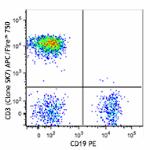
Human peripheral blood lymphocytes were stained with CD19 PE... 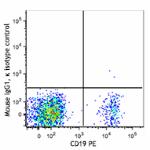
-
Brilliant Violet 421™ anti-human CD3
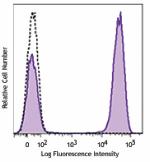
Human peripheral blood lymphocytes were stained with CD3 (cl... -
Brilliant Violet 605™ anti-human CD3
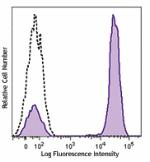
Human peripheral blood lymphocytes were stained with CD3 (cl... -
Brilliant Violet 711™ anti-human CD3
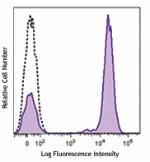
Human peripheral blood lymphocytes were stained with CD3 (cl... -
FITC anti-human CD3

Typical results from human peripheral blood lymphocytes stai... -
PE anti-human CD3

Typical results from human peripheral blood lymphocytes stai... -
Brilliant Violet 785™ anti-human CD3
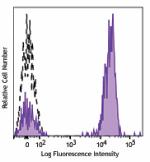
Human peripheral blood lymphocytes were stained with CD3 (cl... -
PE/Dazzle™ 594 anti-human CD3
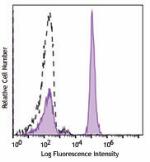
Human peripheral blood lymphocytes were stained with CD3 (cl... -
Brilliant Violet 750™ anti-human CD3
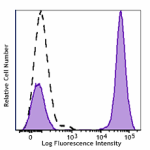
Human peripheral blood lymphocytes were stained with CD3 (cl... -
TotalSeq™-A0049 anti-human CD3
-
PerCP/Cyanine5.5 anti-human CD3
-
TotalSeq™-C0049 anti-human CD3
-
Spark Blue™ 550 anti-human CD3
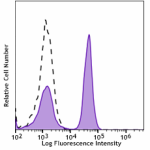
Human peripheral blood lymphocytes were stained with CD3 (cl... -
PE/Cyanine7 anti-human CD3
-
TotalSeq™-B0049 anti-human CD3
-
Alexa Fluor® 660 anti-human CD3
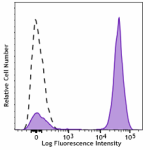
Human peripheral blood lymphocytes were stained with CD3 (cl... -
APC/Fire™ 810 anti-human CD3
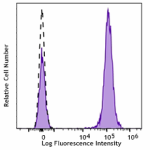
Human peripheral blood lymphocytes were stained with CD3 (cl... -
Spark NIR™ 685 anti-human CD3
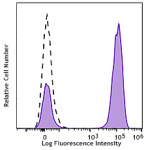
Human peripheral blood lymphocytes were stained with CD3 (cl... -
PE/Fire™ 640 anti-human CD3
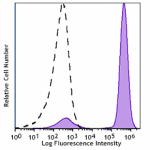
Human peripheral blood lymphocytes were stained with CD3 (cl... -
PE/Fire™ 700 anti-human CD3
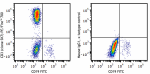
Human peripheral blood lymphocytes were stained with anti-hu... -
APC anti-human CD3

Typical results from human peripheral blood lymphocytes stai... -
PerCP anti-human CD3

Typical results from human peripheral blood lymphocytes stai... -
Biotin anti-human CD3
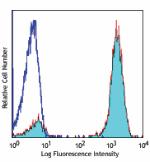
Human peripheral blood lymphocytes stained with biotinylated... 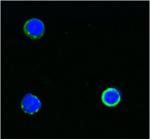
Human PBMCs, stimulated with 1 µg/ml of LPS for 8 h and trea... -
Purified anti-human CD3
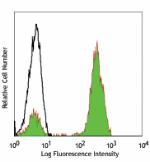
Human peripheral blood lymphocytes stained with SK7 FITC. -
FITC anti-human CD3
Human peripheral blood lymphocytes stained with SK7 FITC. -
PE anti-human CD3
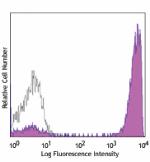
Human peripheral blood lymphocytes were stained with CD3 (cl... -
Alexa Fluor® 488 anti-human CD3
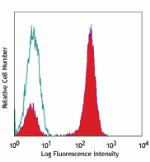
Human peripheral blood lymphocytes stained with SK7 Alexa Fl... -
PerCP/Cyanine5.5 anti-human CD3
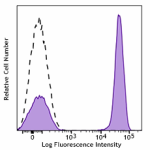
Human peripheral blood lymphocytes were stained with CD3 (cl... -
PerCP anti-human CD3
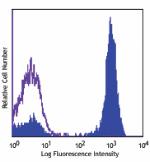
Human peripheral blood lymphocytes stained with SK7 PerCP -
PE/Cyanine7 anti-human CD3
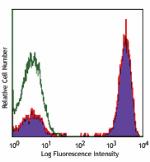
Human peripheral blood lymphocytes stained with SK7 PE/Cyani... -
APC/Cyanine7 anti-human CD3
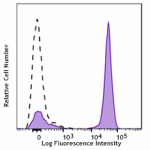
Human peripheral blood lymphocytes were stained with CD3 (cl... -
APC anti-human CD3
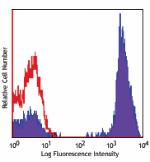
Human peripheral blood lymphocytes stained with SK7 APC -
Alexa Fluor® 700 anti-human CD3
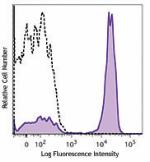
Human peripheral blood lymphocytes were stained with CD3 (cl... -
Pacific Blue™ anti-human CD3
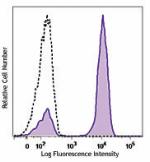
Human peripheral blood lymphocytes were stained with CD3 (cl... -
Alexa Fluor® 647 anti-human CD3
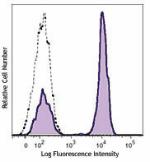
Human peripheral blood lymphocytes were stained with CD3 (cl... -
Brilliant Violet 510™ anti-human CD3
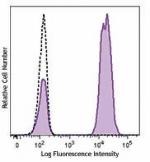
Human peripheral blood lymphocytes were stained with SK7 Bri... -
APC/Fire™ 750 anti-human CD3
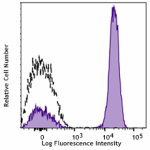
Typical results from human peripheral blood lymphocytes stai... -
GMP FITC anti-human CD3
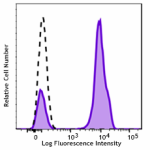
Typical results from human peripheral blood lymphocytes stai... -
PE/Cyanine5 anti-human CD3 Antibody
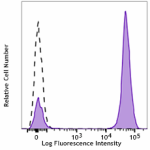
Human peripheral blood lymphocytes were stained with anti-hu... -
GMP PE anti-human CD3
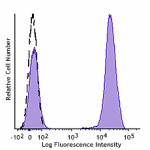
Typical results from human peripheral blood lymphocytes stai... -
GMP APC anti-human CD3
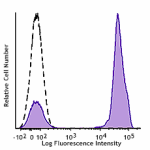
Typical results from human peripheral blood lymphocytes stai... -
GMP PerCP/Cyanine5.5 anti-human CD3
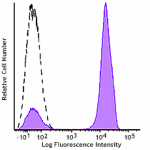
Typical results from human peripheral blood lymphocytes stai... -
Spark YG™ 593 anti-human CD3
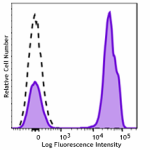
Human peripheral blood lymphocytes were stained with anti-h... -
GMP PerCP anti-human CD3
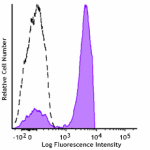
Typical results from human peripheral blood lymphocytes stai... -
Spark Violet™ 500 anti-human CD3
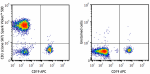
Human peripheral blood lymphocytes were stained with anti-hu... -
Brilliant Violet 650™ anti-human CD3
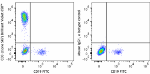
Human peripheral blood lymphocytes were stained with anti-hu... -
Spark Violet™ 500 anti-human CD3

Typical results from human peripheral blood lymphocytes stai... -
Spark PLUS UV395™ anti-human CD3
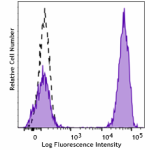
Human peripheral blood lymphocytes were stained with anti-hu... 
Human peripheral blood lymphocytes were stained with anti-hu... -
Spark YG™ 581 anti-human CD3 (Flexi-Fluor™)
-
PE/Fire™ 744 anti-human CD3

Human peripheral blood lymphocytes were stained with anti-hu... -
Spark PLUS V450™ anti-human CD3

Human peripheral blood cells were stained with anti-human CD...


Follow Us